 RankASO
App Store keyword research: how to pick keywords you can win
Read in: 日本語 · 简体中文 · Português · Español · Deutsch
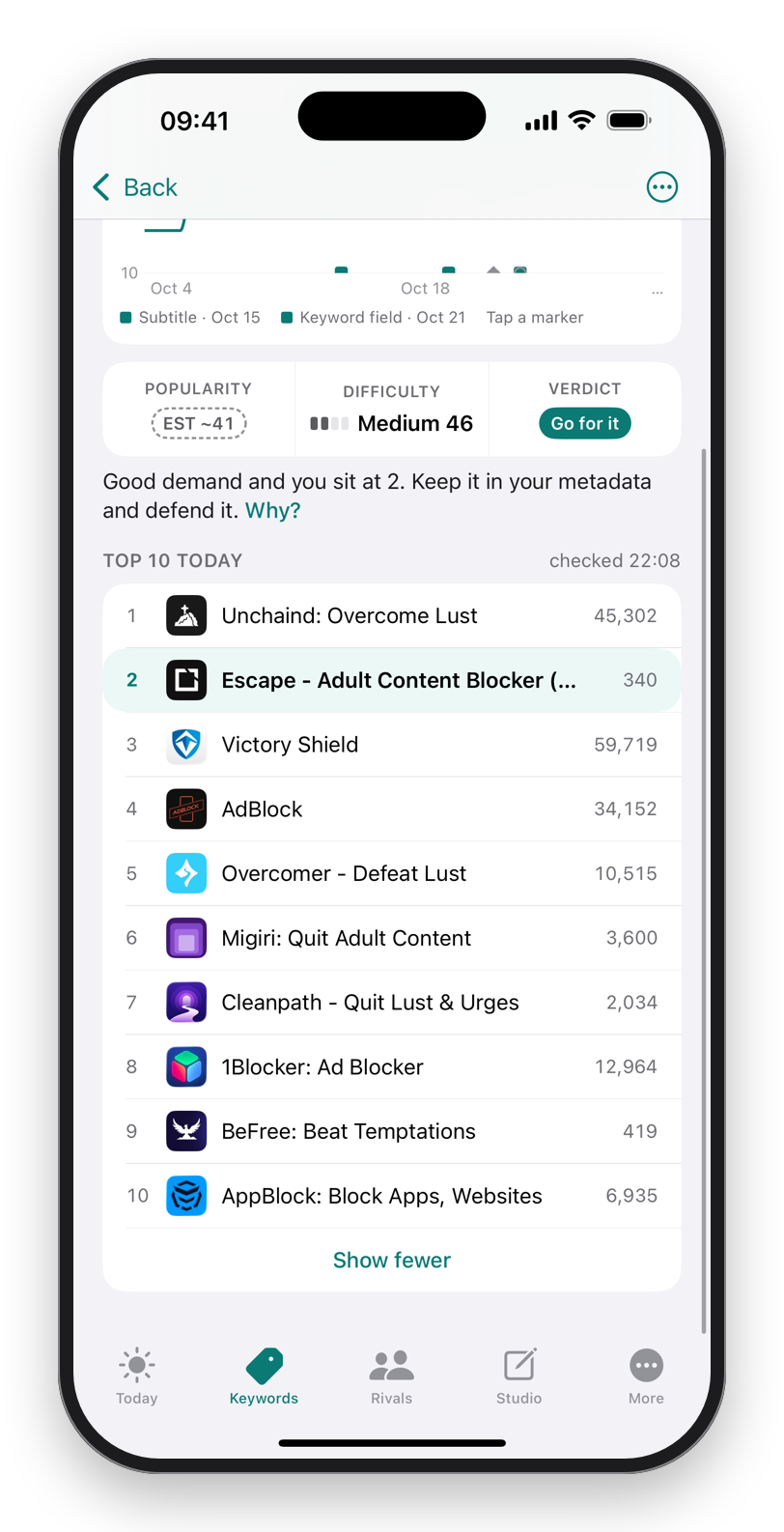
App Store keyword research comes down to three numbers per term: how much demand it has, how hard the top 10 is to break into, and where you stand today. Demand without a path is a wall; an easy term nobody types is a trophy. The terms worth your hundred characters are the ones with real demand, a top 10 you can beat and a current rank close enough to move. RankASO turns those three into a one-word verdict for every term, Go for it, Climbable, Long shot or Skip, and shows the facts behind it. Here is how to read them, with our own app's terms as the example.
Popularity: is anyone typing it
Popularity is a demand estimate from 5 to 100. It is built from what the store itself suggests and from the depth of the results, and it is shown as an estimate, with a tilde, because that is what it is. Treat it as a ranking of your own terms against each other: the ones at the top deserve your attention first. Do not treat the number as a count of searches.
The phrases the store completes when you type the first word are the ones with demand. Discover in RankASO reads those completions for the seeds you give it and scores each one, so the research starts from phrases people actually type rather than from a blank page.
Difficulty: who holds the top 10
Difficulty is read from the ten apps that hold the term today and their rating counts. A top 10 of apps with a few hundred ratings each is open; a top 10 where every slot has a hundred thousand is a wall. The term's own words appearing in those apps' names make it harder still, because the store rewards the name heavily. Four bands: Easy, Medium, Hard, Wall.
This is the number most indie developers skip, and it is the one that saves the most wasted characters.
Your rank: how far is the move
A term where you rank 15 can be moved into the top 10 by one better word in the subtitle. A term where you rank 150 cannot be moved by anything short of a new name. Current rank, next to demand and difficulty, is what turns a research list into a plan.
The verdict
| Verdict | What it means | What to do |
|---|---|---|
| Go for it | Real demand, an open top 10, and you are within reach | Put the words in the listing now |
| Climbable | Demand and a beatable top 10, or you are already close | Next field change |
| Long shot | High demand but a hard top 10, or you are far away | Only if nothing else is left |
| Skip | Too little demand, or a wall | Spend the characters elsewhere |
Every verdict opens a Why? sheet listing the popularity, the difficulty, your rank and the rule that fired, so you can disagree with it on facts.
One app's terms, read this way
Escape's tracked terms on October 31, 2026, in the US store:
| Term | Popularity | Difficulty | Rank | Verdict |
|---|---|---|---|---|
| quit corn | ~64 | Easy | 11 | Go for it |
| site blocker | ~84 | Medium | 17 | Climbable |
| chrome blocker | ~43 | Hard | 19 | Climbable |
| web filter | ~85 | Easy | past 200 | Climbable |
| reboot | ~80 | Easy | 61 | Climbable |
| abstinence | ~90 | Hard | 60 | Long shot |
| safari blocker | ~88 | Wall | past 200 | Skip |
| adult content blocker | ~89 | Medium | 1 | Go for it, held |
The plan wrote itself. "quit corn" and "site blocker" kept their characters and "web filter" earned a goal; "safari blocker", a wall held by the browser itself, lost its word in the next keyword field; the number one was left alone because the name already carries it. Two weeks after the release, the before-and-after view says which of those calls were right.
The method, in five steps
- Seed Discover with the two or three words that describe your app and read the completions.
- Track everything with a verdict of Climbable or better. Thirty terms is plenty to start.
- Sort by verdict, then by rank. The Go for its where you rank 11 to 50 are the list.
- Put their words in the name, subtitle or keyword field, with the rule checker open.
- Record the baseline, ship, and compare two weeks later.
Download on theApp StoreFree to start. No account. Data Not Collected.
Questions
How many keywords should an indie app track?
Twenty to forty per storefront. Enough to cover your name words, your subtitle words and the phrases people complete, few enough that you read the list every morning.
Should I target high-popularity keywords?
Only when the top 10 says you can. A high-demand term held by ten huge apps is a Long shot; a modest term with a weak top 10 where you already rank 20 is where installs come from.
What is keyword difficulty based on?
The apps that hold the top 10 for that term today: how many ratings they have, how many are giants, and whether the term's words are in their names. It is read fresh with every daily check.