 RankASO
Why your rank differs from what you see in the App Store app
Read in: 日本語 · 简体中文 · Português · Español · Deutsch
Search the App Store on your own phone and your app often appears a place or two higher than a stranger would see it, because the store personalises results by what you have installed, downloaded and searched. Your own app is something you have obviously installed. A rank tracker reads the neutral result for a storefront instead, the one a user with no history sees, which is the number that moves when you change your listing and the one worth making decisions on. Here is why the two differ, how far, and when each matters.
What the store personalises
The order of search results is adjusted for the individual: apps already on the device, apps downloaded before, previous searches, and some signals from the Apple ID's country and language. The adjustment is small for most terms and large for a few, and it is largest for the apps the person already has, which, for a developer, is their own app. It also explains why a friend in the same country can report a different rank on the same term the same morning.
What a tracker reads
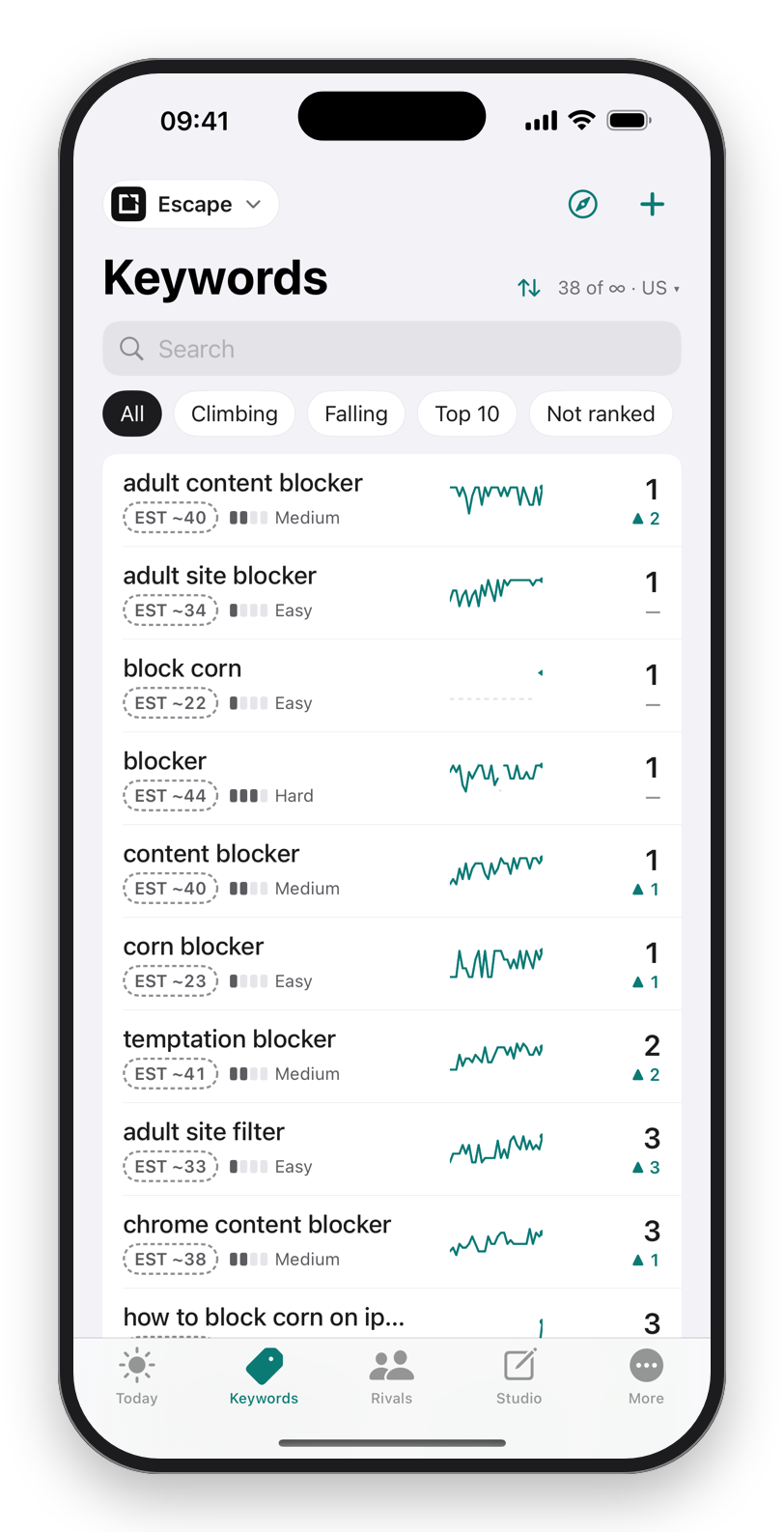
The neutral result: the storefront's ordering for a user with no history, read at a consistent hour. This is the rank a new user is most likely to see, and the one the store's own index produces before adjusting it for anyone. RankASO reads it for every term and storefront you track, every morning, to position 200. Because every rival's rank is read from the same neutral result, the gaps between you and them are also real rather than coloured by what is on your phone.
How far apart the two usually are
For most terms, one to three places. For your own app on a term where it sits in the top 10, often one or two places better on your phone than in the neutral result. For a term where you rank 40, the personalised view can put you at 30 and give you a decision you would not have made with the real number. Over weeks, the neutral series is stable and moves in steps; the personalised reading drifts with your own usage.
Which number to use for what
- Deciding whether to change the listing: the neutral rank. It is what responds to the words.
- Comparing with a rival: the neutral rank, from the same search. Two personalised readings on two phones are not comparable at all.
- Checking that a new version is indexed at all: your own phone is fine, and faster.
- Showing a friend: your own phone, with the caveat.
The practical rule
Never record a rank from your own phone's App Store into anything you will compare later. If the only tool you have is the App Store app, sign out of the storefront you are checking or use a device with nothing installed, and accept that it is still not the neutral result. If you have a tracker, let it be the record, and use the App Store app for what it is: the store, personalised for you.
Download on theApp StoreFree to start. No account. Data Not Collected.
Questions
Why does my app rank higher on my own phone?
Because the App Store personalises search results by what is installed and downloaded on the device, and your own app is installed. A new user sees the neutral result, which is usually a place or two lower.
Which rank is correct, the App Store app or the tracker?
Both are real for the person seeing them. The tracker's neutral rank is the one a new user sees and the one that responds to your listing, so it is the one to make decisions on.
Can I see the neutral App Store search result myself?
Not reliably from a phone with history. A tracker reads the storefront's result for a user with no history, which is what RankASO records every morning.