 RankASO
The visibility score: one number for how much demand you hold
Read in: 日本語 · 简体中文 · Português · Español · Deutsch
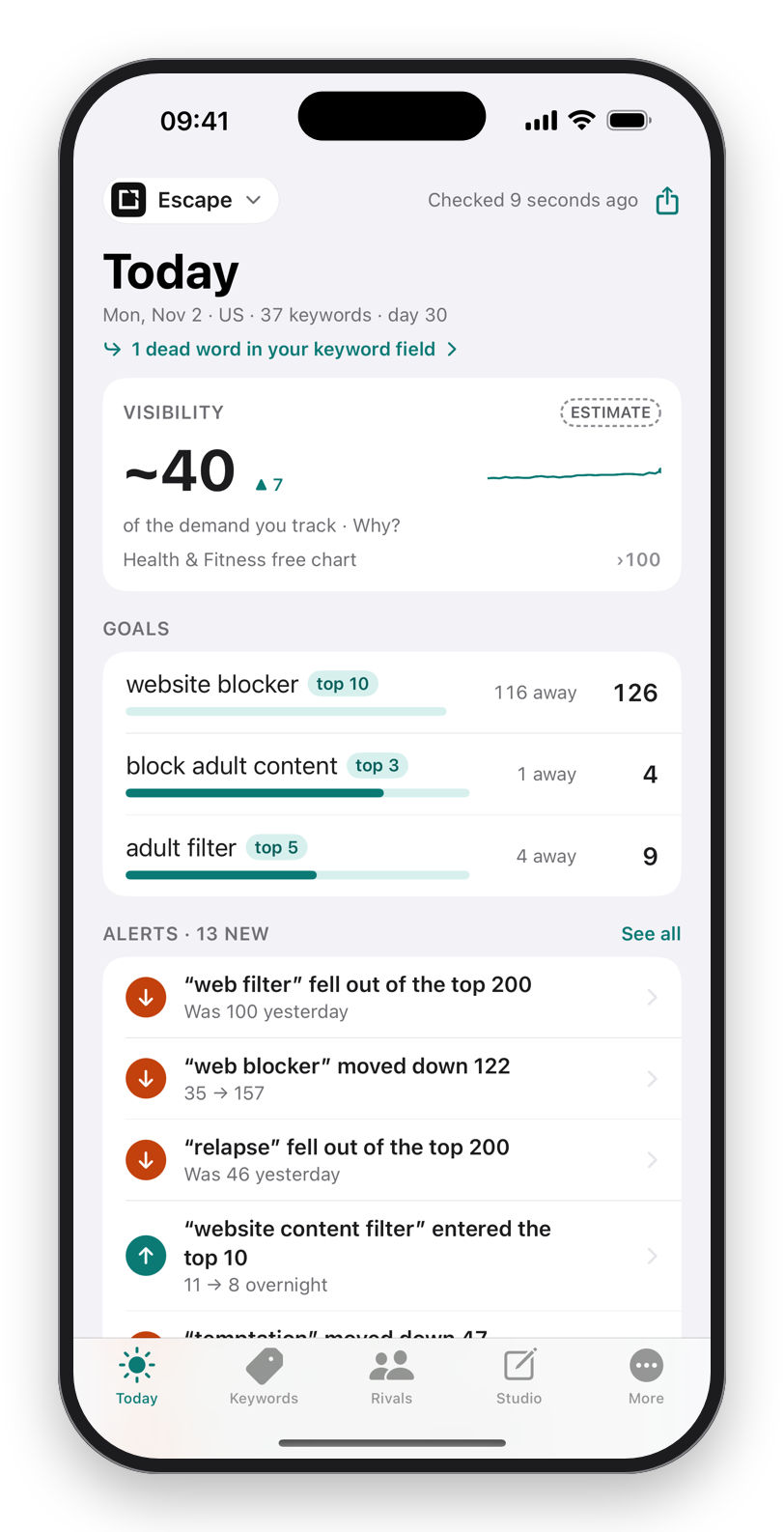
The visibility score is one number, 0 to 100, for how much of the demand on your tracked terms your app currently holds, weighted so that a top rank on a busy term counts more than a top rank on a quiet one, and a rank nobody scrolls to counts for almost nothing. It sits at the top of RankASO's Today screen and in the widget, and its only job is to let a glance answer the question that thirty ranks cannot: is the listing gaining or losing. Here is what goes into it, what moves it, and what it should not be used for.
What goes in
Every tracked term in every tracked storefront, with its demand figure and your rank on it. A rank on the first screen of results holds most of that term's demand; a rank in the teens holds some; a rank past 50 holds almost none. The score is the share you hold across all of them, as a percentage of what you would hold if you were first on everything. Where Apple's own demand figures are connected, the weighting uses them and the score says so; otherwise it uses the estimate, labelled with a tilde.
What moves it
- A term entering or leaving the top 10, especially a busy one. This is the usual reason the number changes.
- A new term added to tracking. The score reflects the terms you watch, so adding a busy term you rank poorly on lowers it. That is correct: your visibility across the demand you care about just got measured more honestly.
- A storefront added. Same effect, per country.
- A rival's listing change that pushes you down a place on several terms at once.
- A version re-indexing, as a step a few days after release.
Day-to-day flicker of a point is noise. A move of five points in a week is a story, and the Today screen lists the terms that caused it below the number.
What it is not
It is not a share of the whole market; it is a share of the terms you chose to track, and it is only as honest as that list. It is not comparable between apps that track different terms. It is not a ranking factor; the store does not see it. And it is not a substitute for reading the terms: the score says that something moved, the list says what, and the top 10 on the term says why.
How to use it
Read it once a day with your coffee. Flat is the normal answer and needs nothing. A fall of a few points is the cue to open the list and find the term, then the term's top 10, then the rival or the version that explains it. A rise after a version is the first sign the change worked, two weeks before the release-impact view confirms it term by term. Over months, the score is the one line that shows whether the weekly loop is paying.
For our own app
Escape's score is a share of the demand on its forty-odd tracked terms, held mostly through six number ones and a cluster of top-10s in Canada. Most mornings it does not move. The mornings it does are the mornings worth ten minutes, and the number is how we know which mornings those are.
Download on theApp StoreFree to start. No account. Data Not Collected.
Questions
What is an app visibility score?
One number for the share of demand on your tracked terms that your app holds, weighted by each term's demand and by how high you rank on it. In RankASO it is 0 to 100 and sits on the Today screen.
Why did my visibility score drop when I added keywords?
Because the score measures the terms you track, and you added demand you do not yet hold. It is now a more honest measure of the same listing; it did not get worse.
Is the visibility score the same as App Store ranking?
No. Rankings are per term and storefront; the score folds them into one line so that a glance tells you whether to open the list.