 RankASO
How often to check App Store ranks, and why daily is honest
Read in: 日本語 · 简体中文 · Português · Español · Deutsch
Check App Store ranks once a day, at the same hour, for every term and storefront you care about, and record the days you missed as missed. More often is noise: the store's index does not move hour to hour in a way worth reading. Less often is blindness: a weekly check misses the drop that cost a week of installs. The same hour is the part most people skip, and it is why their charts wobble. RankASO checks every morning at a consistent time, and that one decision is behind most of what the app can tell you.
Why the hour matters
The store updates its index on its own schedule, and a rank read at 8 a.m. and one read at 6 p.m. can straddle an update. A check that happens whenever you open the app produces a series where some moves are real and some are the clock. Fix the hour, and a move of three places is three places. RankASO runs the daily check in the background at a consistent time, and a manual pull-to-refresh is for the moments you need a reading now, not the series.
Why daily and not weekly
Ranks move in steps: a version re-indexes, a rival ships a listing, a seasonal term wakes up. A step that happens on Tuesday and is read on Sunday has already cost five days, and a weekly series cannot show whether the fall was one step or a slide. Daily is the cadence at which a step is a step and an alert can fire the morning it happens.
Why not hourly
Because the index does not reward it. Hourly readings show the same rank twenty times and a flicker of one or two places that means nothing, and they make a chart that hides the real moves in jitter. There is no decision in ASO that needs to know a rank at 3 p.m. and again at 4 p.m.
Missed days are missed, not filled
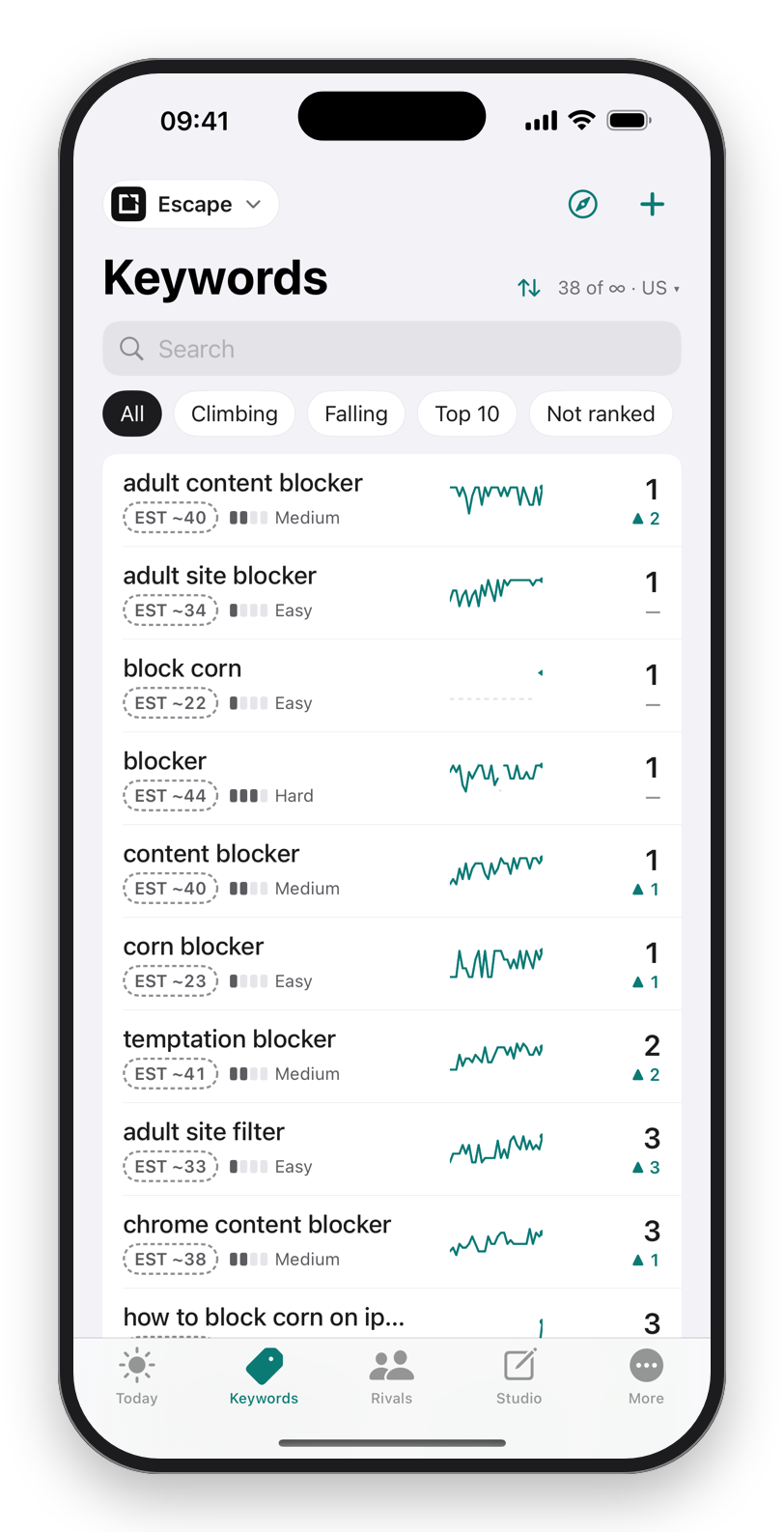
A day the check could not run, because the phone was off or the store did not answer, is a gap. The honest chart draws it as a gap, with a dashed marker, and the honest tracker never copies the last value into it. A filled gap looks like a flat week and hides the step that happened inside it. RankASO stores missed days as missing and draws them that way.
Rivals at the same moment
Daily and same-hour also make rival ranks comparable. Your rank and a rival's rank are only side by side if they come from the same search result; a rival checked an hour later on a separate search is a different reading. One search per term per storefront per day, with every rival read from that result, is the method, and it costs nothing extra.
What the cadence makes possible
A baseline on the day you submit a version. A before-and-after at two weeks. A goal whose distance closes one day at a time. A drop diagnosed as yours, a rival's or the term's, from the top 10 on the morning it happened. None of those exist without the daily series, and all of them are what the Today screen shows when you open it with your coffee.
Download on theApp StoreFree to start. No account. Data Not Collected.
Questions
How often should I check my App Store keyword rankings?
Once a day, at the same hour, for every term and storefront you track. Daily catches the steps; the fixed hour removes the clock from the chart.
Do App Store rankings change every hour?
They flicker by a place or two, which is noise. Meaningful moves happen as steps when listings re-index or competitors change, and a daily series shows them cleanly.
What should a rank tracker do about a missed day?
Store it as missing and draw it as a gap. Filling it with the last value hides a step and makes a flat line out of a week that was not flat.