 RankASO
Rank tracking after a metadata update: week by week
Read in: 日本語 · 简体中文 · Português · Español · Deutsch
After a metadata update your ranks do nothing for a few days, then move in a burst as the store re-indexes the new words, then settle over about two weeks. Reading the result before day three tells you nothing; reading it after day fourteen is the honest comparison. The one thing that makes the comparison possible is a baseline recorded the day you submitted, which is why RankASO records one automatically and puts the seven days before the version beside the seven days after. Here is the week-by-week shape, and what to do at each point.
Day 0: submit, and record the baseline
The baseline is every term's rank in every storefront on the day you submit. Without it you will compare the new ranks against your memory, and memory is kind. RankASO's Release impact view takes the baseline from the daily checks that were already running, so there is nothing to do except not change anything else for two weeks. One change per version, or you cannot tell which change worked.
Days 1 to 3: nothing, and that is normal
The version goes live and the ranks stay where they were. The store has not re-indexed the listing yet. Do not read anything into these days, and do not change the field again because it "did not work".
Days 3 to 7: the burst
Re-indexing lands as a step, not a slope. Terms whose words you added appear, often far down, sometimes straight into the top 50. Terms whose words you removed drop, sometimes to past 200 within a day. This is when alerts earn their keep: RankASO sends one when a term enters or leaves the top 10 or makes a big move, so you see the step the morning it happens instead of discovering it at the review.
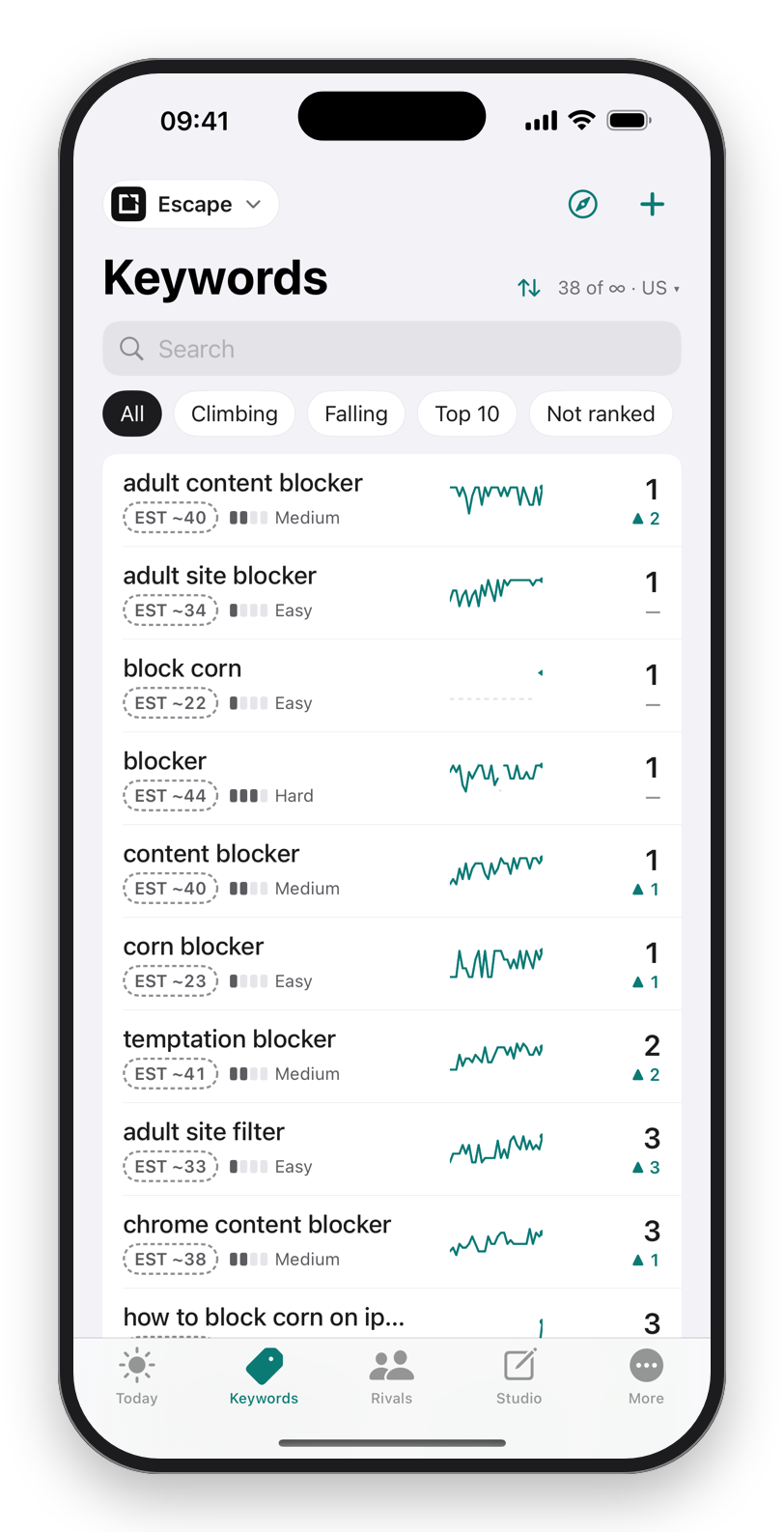
For Escape's November version we recorded the baseline on November 3: "abstinence" at 62 in the US and 32 in the UK, "nnn" at 31, "pmo" at 92, "reboot" at 60. The words we removed were expected to lose their ranks and the words we added to gain some; the baseline makes both claims checkable rather than felt.
Days 7 to 14: the settle
New terms climb or sink to where the store thinks they belong as it gathers taps. Old terms that dropped either recover partly, because another word in the listing still carries them, or confirm the loss. Movement slows. By day fourteen the picture is stable enough to judge.
Day 14: the review, term by term
Open the before-and-after. Three outcomes, three actions.
- Up: keep the words, set a goal to the top 10 if the term is not there yet.
- Down: the removed word was carrying the term. Decide whether what you gained is worth it; if not, put it back next version.
- Flat: that word was not the constraint. The subtitle or the name is where the next change goes.
Write one line in the journal. Twelve of those lines are a year of knowledge about your own app.
What is not a result
A term moving in the first three days is noise from the old index. A rank read on your own phone in the App Store app is personalised and not comparable to the baseline. A single day's dip during the settle is not a trend. The tracker's job is to make all three impossible to mistake for a result, by checking at the same hour every day, reading the neutral storefront result, and drawing missed days as missed.
Download on theApp StoreFree to start. No account. Data Not Collected.
Questions
How long does the App Store take to index new keywords?
Usually a few days after the version is live, landing as a step rather than a gradual climb. Judge the change at two weeks, not before.
Should I track ranks daily during a metadata update?
Yes, at the same hour every day, so the before-and-after compares like with like. RankASO does this on its own and records the baseline on the day you submit.
What if my ranks dropped after the update?
Find the removed word that was carrying the dropped term; the field report shows what each word earns. Put it back next version if the loss outweighs what the new words gained.