 RankASO
Which storefronts to track first, out of 175
Read in: 日本語 · 简体中文 · Português · Español · Deutsch
The App Store is 175 storefronts, each with its own search results, and an app's ranks differ between them more than most developers expect. Tracking all of them is noise; tracking only the one your phone is set to is blindness. Start with two: the storefront most of your downloads come from, and the one you suspect is next. Then run one wide check across many storefronts to find the one you did not suspect. For our own app Escape that check found Canada, holding eighteen of twenty top-10 terms on a fraction of the US downloads.
Day one: two storefronts
App Store Connect tells you where downloads come from. The top country is storefront one. Storefront two is the next English-speaking country or the one where your category is strongest. Track your thirty terms in both; RankASO's free plan covers two storefronts, and every term is checked in each every morning.
Week two: the wide check
A World Check in RankASO reads one term across many storefronts at once and shows where you rank in each. Run it on your three best terms. The storefronts where you sit in the top 10 without having tried are the ones where your listing's words happen to fit the local competition. Those are cheap wins to defend and often the best place to localise next, because the audience is already finding you.
Escape's wide check showed Canada at eighteen of twenty top-10 terms with five number ones, the UK and India at thirteen and fourteen of twenty, and the US, the main market, in between. The US had the downloads; Canada had the ranks. That reordered the work: the Canadian fields got attention, and the English (UK) field, which the UK, India and Australia all read, became a single lever for three storefronts.
Which storefronts share a field
Several storefronts read the same locale, so one field change moves several countries at once. English (UK) is read by the UK, Australia, India, Ireland and more. Spanish (Mexico) is read across Latin America and inside the US. Portuguese (Brazil) is read in Brazil. Picking storefronts to track is also picking which fields are worth the characters. What each storefront reads.
Grow to five, not fifty
Add a storefront when it earns it: a share of downloads, a top-10 position found by the wide check, or an ad campaign running there. Five well-chosen storefronts cover most indie apps. Beyond that the daily list stops being read, and a tracker nobody reads is a subscription, not a tool. Pro tracks up to 175 for the apps that need it; most do not.
Read them side by side
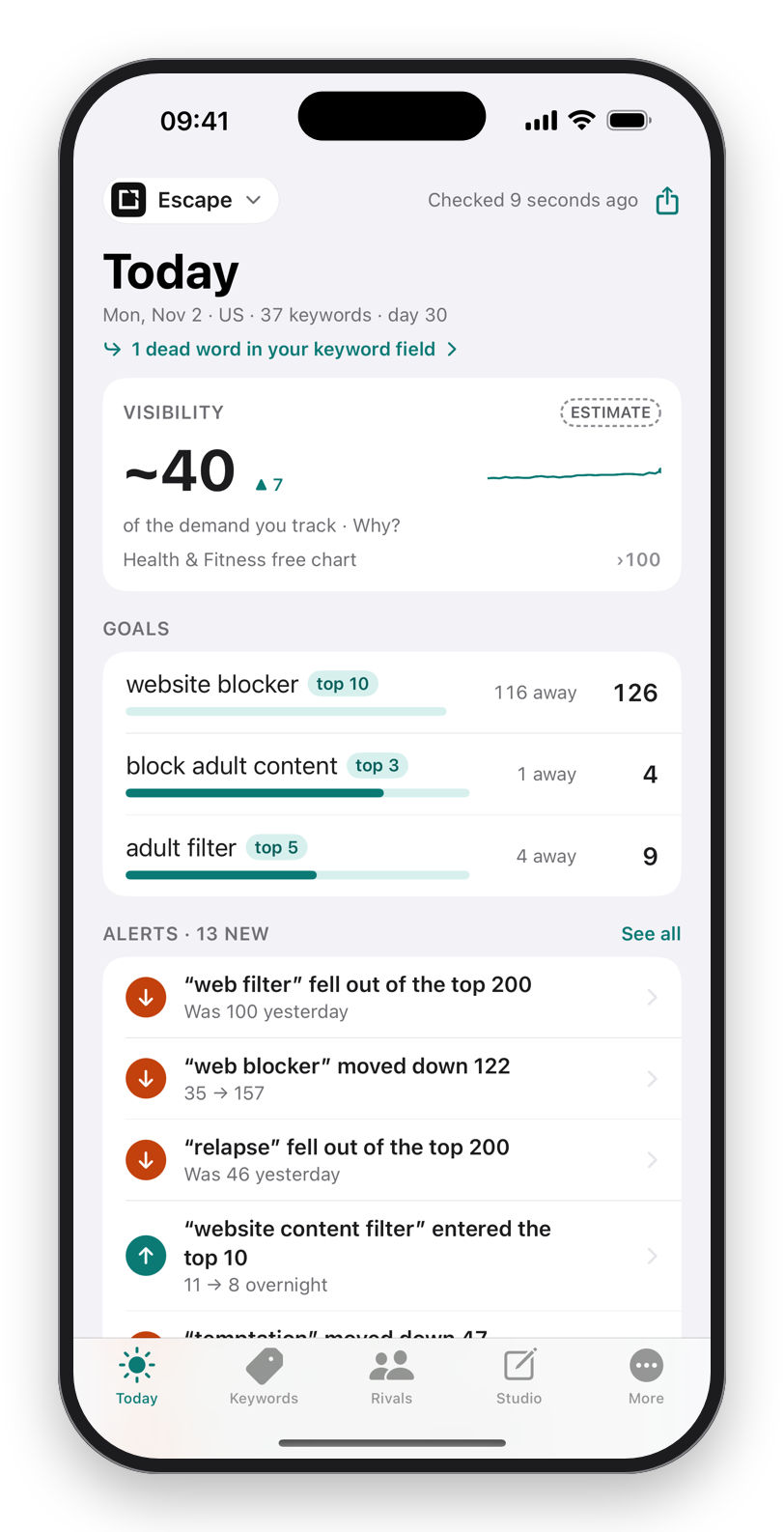
The same term at 1 in Canada, 17 in the US and past 200 in Germany is three different problems: defend, climb, and either localise or ignore. RankASO shows the rank per storefront on each term's screen and a visibility score per storefront on Today, so the morning read is a row per country, not a blended number that hides all three.
Download on theApp StoreFree to start. No account. Data Not Collected.
Questions
How many App Store storefronts should I track?
Two on day one: where your downloads come from and the one you suspect is next. Grow to about five as the wide check and your downloads justify them.
How do I find which countries my app ranks well in?
Run a wide check on your best terms across many storefronts. RankASO's World Check shows the rank per storefront in one table; the surprise storefront is usually there.
Do different countries see different App Store search results?
Yes. Each storefront ranks its own result from its own locale's fields and its own competitors. The same term can be number one in one country and absent in another.