 RankASO
Localizing the keyword field: what each storefront reads
Read in: 日本語 · 简体中文 · Português · Español · Deutsch
Localizing the keyword field is not only about reaching other countries. Several storefronts read more than one locale's fields, so a second locale is a second hundred characters indexed in the same country. The US store reads the English (US) fields and the Spanish (Mexico) fields, among others; Canada reads English (Canada) and French (Canada) together; the UK, Australia and India read English (UK). Our own app Escape ranks in the US store for Spanish terms it never put in its English field, and uses the French Canadian field to carry English words the English one has no room for. Here is how to use it.
Which locales a storefront reads
Each storefront has a primary locale and reads one or more secondary ones. The pairs that matter most for an English-language indie app:
| Storefront | Reads |
|---|---|
| United States | English (US), Spanish (Mexico) and others |
| Canada | English (Canada) and French (Canada) |
| United Kingdom, Australia, India and others | English (UK) |
| Mexico and most of Latin America | Spanish (Mexico) |
| Brazil | Portuguese (Brazil) |
The consequence: every secondary locale you fill is extra indexed words in the primary storefront, not just a translation for another country.
What Escape earns through it
Escape's Spanish (Mexico) field is bloqueador,sitios,filtro,vicio,impulso,recaida,abstinencia,tentacion,habito,adiccion,adulto,bloquear. In the US store, read through that field, the app ranks 4 for "filtro adulto" and 6 for "recaída". Those are US searches by Spanish-speaking users, reached with zero characters of the English field. The French Canadian field carries "sobriety" and "screen time", English words there was no room for in the English Canadian field, and Canada reads both fields together.
The three uses
- A second hundred characters in your main storefront. Fill the secondary locale your main storefront reads, with the next tier of terms from your Gaps list and the store's completions. In the US, that is Spanish (Mexico).
- A real translation for a market you want. Build that storefront's list from its own completions, not from a translation of the English list; searchers phrase things differently, and the store completes differently.
- English words in a non-English field, where a storefront reads both. Canada's French field can carry English terms, which is what Escape does.
Track it per storefront
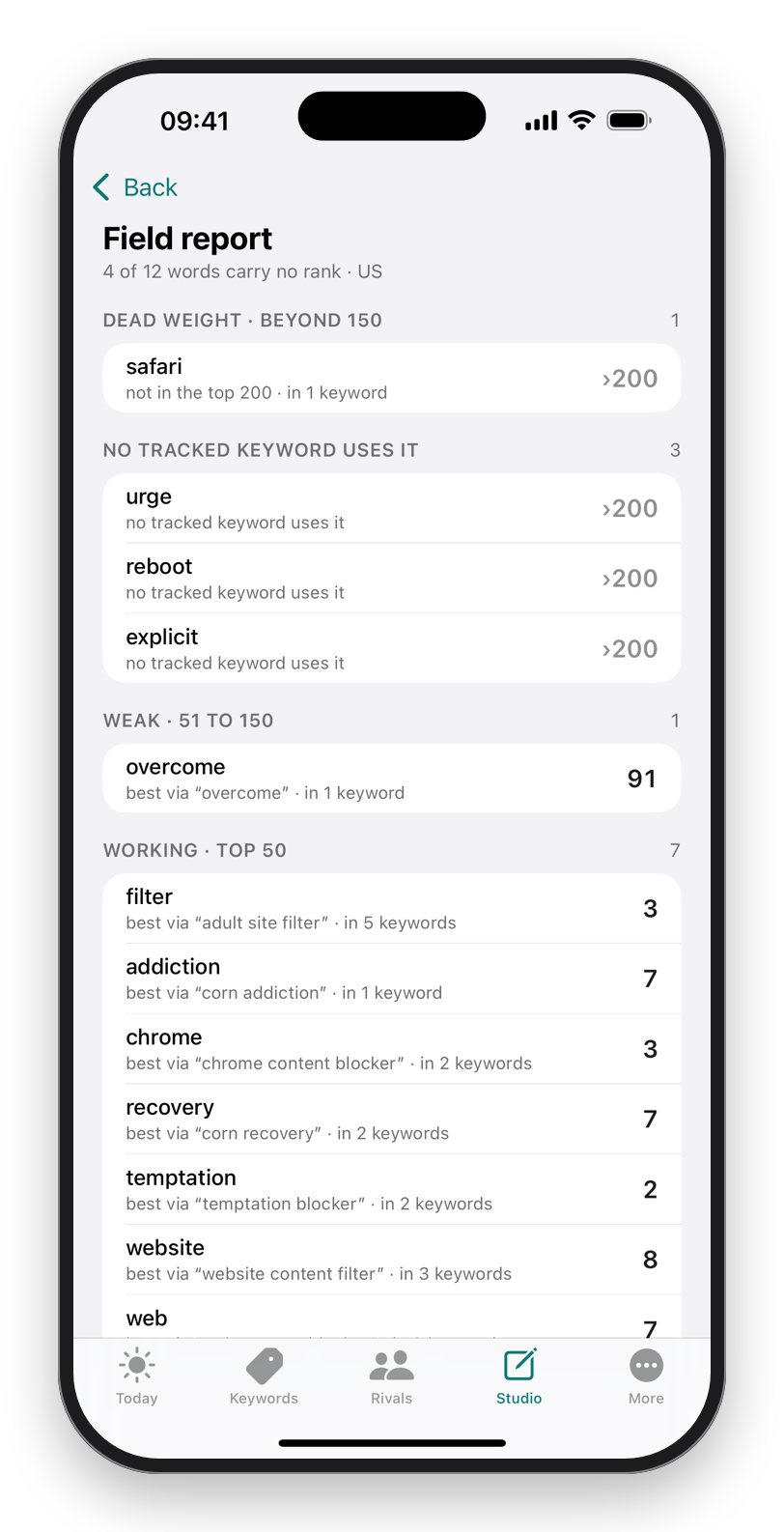
The field report in RankASO is per storefront, so a word in the Spanish field is judged by the US ranks it earns, and a word in the French Canadian field by the Canadian ranks. Track the terms in the language they are typed. The coverage simulator reads each storefront's locales together, so a Canadian term covered by the French field shows as covered in Canada, not missing.
The rules still apply
Each locale's field is 100 characters, commas, no spaces, no words already in that locale's name and subtitle, no plurals, nothing the store ignores. The rule checker runs per locale. And a localized name or subtitle changes what the storefront shows searchers, so a localized title is a conversion decision as well as a ranking one.
Download on theApp StoreFree to start. No account. Data Not Collected.
Questions
Does the US App Store read the Spanish keyword field?
Yes. The US storefront indexes the Spanish (Mexico) localization's fields alongside English (US), so Spanish words earn US ranks. Escape ranks 4 in the US for "filtro adulto" that way.
Can I put English keywords in a French localization?
Yes, and in Canada it is useful, because the Canadian storefront reads English (Canada) and French (Canada) together. The French field becomes extra characters for English terms.
Should I translate my keyword list or research it per country?
Research it. Each storefront completes different phrases and ranks different competitors. Build the list from that storefront's completions and track it per storefront.