 RankASO
Apple Ads by country: separate campaigns, separate ceilings
Read in: 日本語 · 简体中文 · Português · Español · Deutsch
Apple Ads should run as one campaign per country, each with its own cost-per-install ceiling, because what a download earns you differs by country more than what a tap costs does. A single global campaign averages the two together and quietly loses money in the countries where the price tier is lower or renewals are weaker. The ceilings come from your own App Store Connect numbers; the decision about which countries to advertise in at all comes from your organic ranks per storefront, which a daily tracker already has.
Why the economics differ per country
Three things move: the price tier of your app in that country, the share of downloaders who pay, and how long they stay. A country with a lower price and the same conversion earns less per download. A country with the same price and weaker retention earns less over three months. Tap costs, meanwhile, are set by the auction for the term in that storefront, which follows demand and competition rather than your economics. The gap between the two is what the per-country ceiling protects.
Set a ceiling per country
For each country, divide proceeds by downloads over the horizon you can wait. That is the most an install may cost there. Start bids under it. A country whose proceeds per download cannot support any realistic bid is left organic; running ads there is paying for installs that do not pay back. For our own app Escape, that calculation gave three English-speaking countries three different ceilings and ruled out a fourth market, where our terms had almost no demand.
Read the organic side before you decide where
Before paying anywhere, look at where you already rank. A storefront where your terms sit in the top 10 organically needs ads only to defend positions against rivals' bids, and sometimes not at all. A storefront where you rank 11 to 50 is where ads buy the first screen while the listing catches up, and where the organic lift from ads is strongest. A storefront where you do not rank is where ads are expensive and the page is unproven.
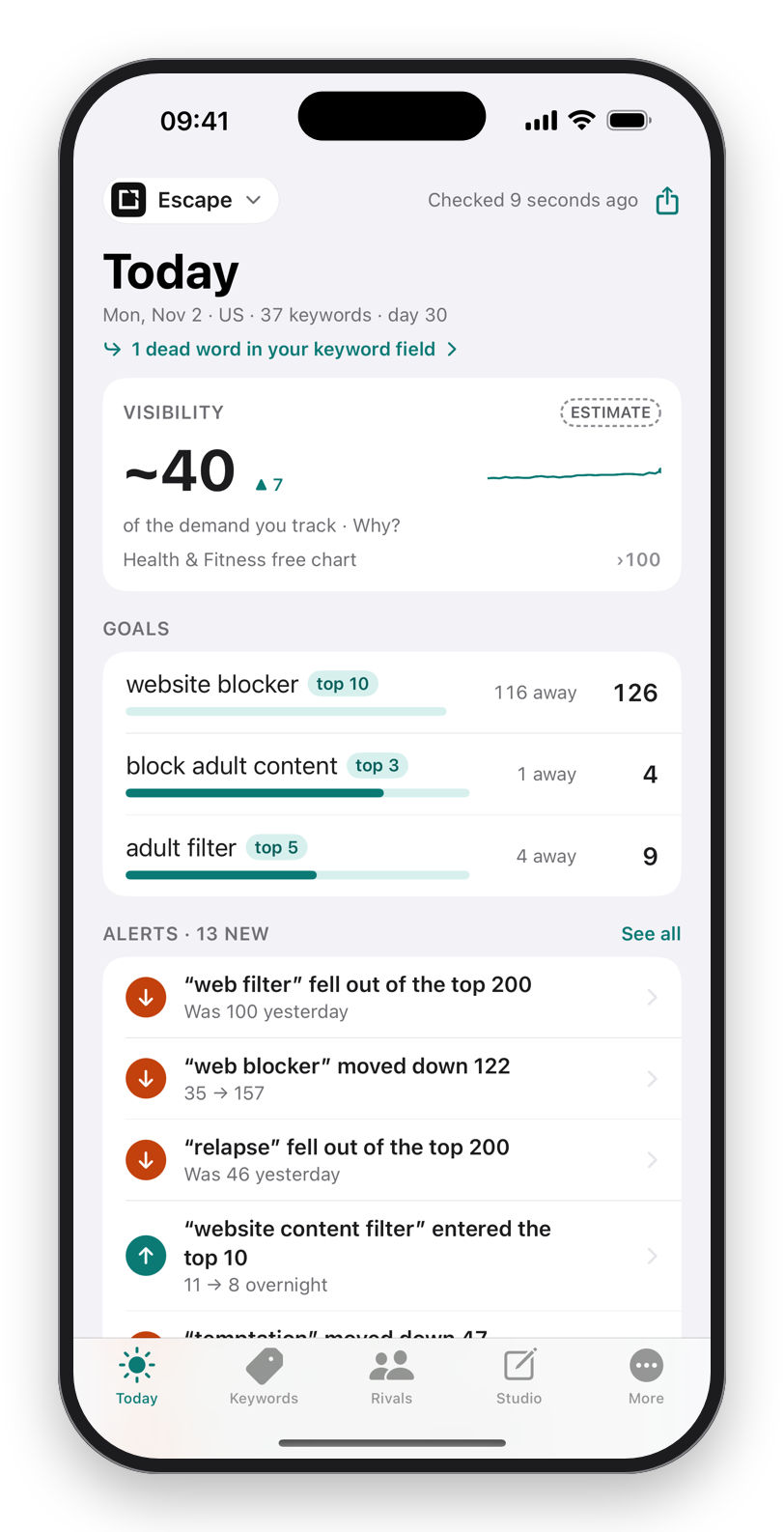
RankASO tracks each term per storefront and its World Check shows one term across many storefronts at once. For Escape, that view showed Canada holding eighteen of twenty top-10 terms with five at number one, on a fraction of the downloads of the US store. That is a storefront where ads defend rather than build, and the budget went elsewhere.
Localise the terms, not just the budget
Searchers in different countries type different phrases for the same thing, and the store completes different suggestions per storefront. Build each country's keyword list from that country's completions and from the terms you rank for there, not from a copy of the US list. The negatives differ too: a word that means a game in one country may mean nothing in another.
The weekly read, per country
One table, one row per country: spend, installs, cost per install against the ceiling, and the organic movement on the advertised terms in that storefront. Countries under the ceiling with organic lift get more budget. Countries over the ceiling get fewer terms or a pause. Countries where the organic rank reached the top 10 on the advertised terms can be cut back; the position is now free.
Download on theApp StoreFree to start. No account. Data Not Collected.
Questions
Should I run one Apple Ads campaign for all countries?
No. One campaign per country, each with its own cost-per-install ceiling from that country's proceeds per download. A global campaign averages away the losses.
How do I decide which countries to advertise in?
Where proceeds per download support a ceiling you can bid under, and where you rank 11 to 50 organically so the ads buy the first screen. Storefronts where you already hold the top 10 need little; storefronts where you have no rank are expensive.
Do I need different keywords per country?
Yes. Build each country's list from that storefront's search completions and from the terms you rank for there. A daily tracker per storefront shows both.