 RankASO
ASO keyword difficulty: how to read the top 10 before you fight
Read in: 日本語 · 简体中文 · Português · Español · Deutsch
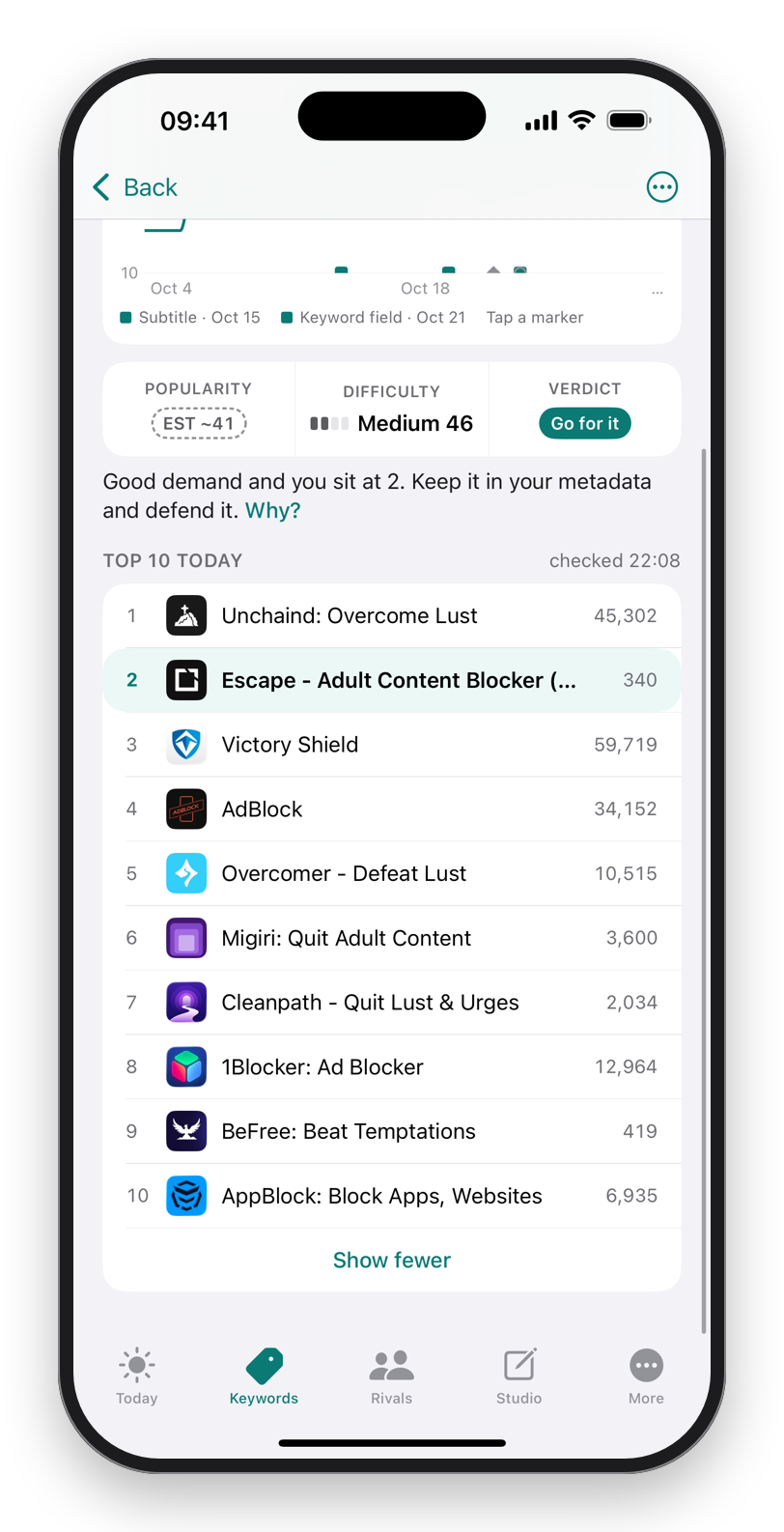
Keyword difficulty in ASO is a reading of the ten apps that hold the term today: how many ratings they have, how many of them are giants, and whether the term's own words are in their names. A top 10 of apps with a few hundred ratings each is open. A top 10 where every slot has a hundred thousand is a wall, whatever the term's demand. Most indie developers never look, which is why they spend characters on walls. RankASO shows the top 10 with ratings on every term's screen and turns the reading into four bands: Easy, Medium, Hard, Wall.
Read the ratings, not the names
Ratings are the public proxy for how established an app is on the store, and the store rewards established apps. Look at the middle of the top 10, not the top: one giant at number one with nine small apps below is an open term with a ceiling of two; nine giants with one small app at ten is a wall. For our own app Escape, "quit corn" had a top app with a few hundred ratings and Escape at 11: Easy, Go for it. "safari blocker" had the browser itself at number one with 180,000 ratings: Wall, Skip, and the word came out of the field.
Count the giants
Apps with six-figure rating counts move for nobody. One in the top 10 is a fact of life; four or more means the term belongs to a category leader's vocabulary and you are fighting for position five at best. The verdict drops to Long shot when the giants pile up, even when the median app is small.
Look for the term's words in their names
The store weighs the name heavily. If most of the top 10 have the term's exact words in their names, the term is theirs by construction and you will need the same words in your own name to compete, which usually means you should not. If few of them do, the term is held loosely, and the same words in your subtitle can move you several places.
Weak slots are your way in
Every app in the top 10 with under a few hundred ratings is a slot you can take with a listing change. Count them. Three weak slots in the top 10 is a Climbable term; "site blocker" for Escape had a medium top 10 with Escape at 17, and a top-10 position there is worth more visibility than a seventh number one on a tiny term.
Put it beside demand and your rank
Difficulty alone is half the story. A term that is Easy because nobody searches it is a trophy. The decision is three numbers together: popularity, difficulty, and where you rank today. RankASO's verdict combines them into Go for it, Climbable, Long shot or Skip and prints the rule it used on the facts sheet, so you can disagree with it on evidence. The three numbers together.
The one-minute habit
Before any word goes into the name, subtitle or field, open the term and read the top 10. If you would not want to be fifth in that list, do not spend the characters. If three of the ten look like you, spend them.
Download on theApp StoreFree to start. No account. Data Not Collected.
Questions
What is keyword difficulty in ASO?
A reading of how hard the ten apps holding a term today are to displace: their rating counts, how many are giants, and whether the term's words are in their names. RankASO shows the top 10 on every term and bands it Easy, Medium, Hard or Wall.
Should I avoid all high-difficulty keywords?
Avoid walls. A Hard term where you already rank in the top 20 can still be worth a word in the subtitle. The verdict weighs difficulty against your rank and the term's demand.
Does difficulty change over time?
Yes, with every app that enters or leaves the top 10. RankASO reads it fresh with each daily check, so a term that opens up shows up as a verdict change.