 RankASO
Review phrases: what your reviewers tell you to rank for
Read in: 日本語 · 简体中文 · Português · Español · Deutsch
Your reviewers describe your app in the words your next users will type, because they are those users a month later. A review that says "finally something that blocks the sites I kept going back to" contains two keyword ideas that no category list would give you. Mining reviews for phrases is the cheapest keyword research there is and almost nobody does it. RankASO reads your reviews and lifts the phrases that could be search terms, with the store's completions checked against them; here is how to do it by hand as well, and what it found for our own app.
Why reviews beat keyword lists
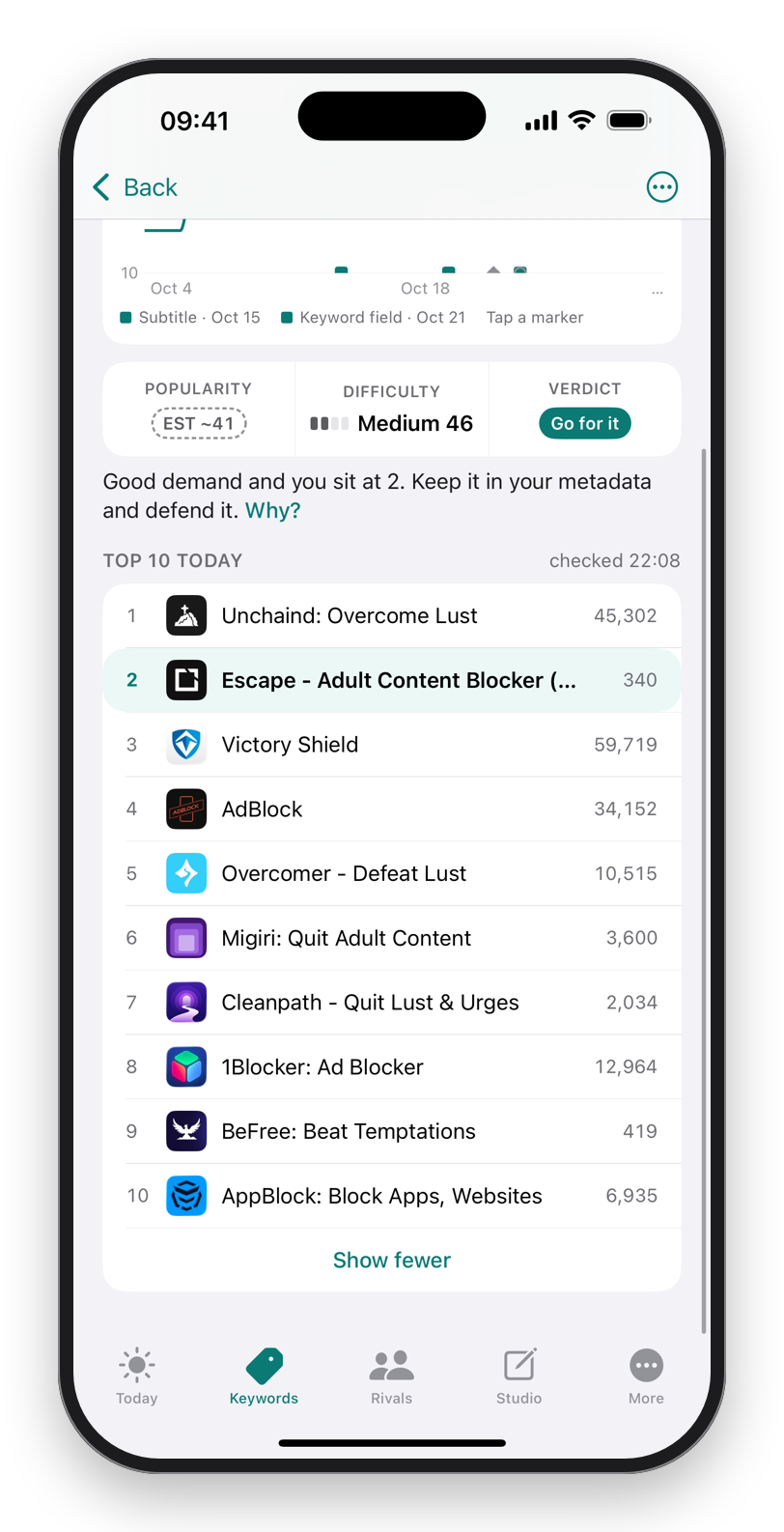
A keyword list tells you what the category calls itself. Reviews tell you what people call their problem. For our own app Escape, reviewers wrote "temptation", "urge" and "relapse" months before any of those words were in the keyword field. They are there now; "temptation blocker" sits at number two in the US store, and "urge" and "relapse" are tracked terms with open top 10s. The category lists never offered them because they are not category words. They are outcome words.
The method by hand
- Read the last fifty reviews, yours and your three closest rivals'.
- Write down every noun and verb that describes the job the app does or the problem it solves. Skip praise and bugs.
- Group the words by meaning. "urge", "temptation", "craving" are one group; "block", "filter", "stop" another.
- For each group, type the strongest word into the store's search and read what it completes. The completed phrases are the keywords.
- Track them. Give them two weeks. Keep the ones with a verdict of Climbable or better.
An hour, once a quarter. The list changes as your users change.
What the app does with reviews
RankASO's review phrases feature reads the reviews on your listing and your tracked rivals' listings, lifts the phrases that look like searches, checks each against the store's completions, and adds the matches to Discover with a score and a verdict. The phrases a rival's reviewers use are especially useful: they describe the job from the point of view of people who chose someone else.
What to do with the phrases
Outcome words go in the subtitle if they combine with the name, or in the field if not. Problem words that the store completes into phrases go in the field. Words that reviewers use but the store never completes stay out of the listing and into the screenshots instead, where they still convert. The field report tells you a quarter later which of them earned a rank.
The phrase that is not a keyword
Reviewers also write what they wish the app did. That is a roadmap, not a keyword, until you ship it. Putting a feature you do not have in the field earns a rank you cannot convert and a review you do not want.
Download on theApp StoreFree to start. No account. Data Not Collected.
Questions
Can App Store reviews help with keyword research?
Yes. Reviewers describe the app in the words new users type, including outcome and problem words that category lists never contain. Read fifty, list the nouns and verbs, check them against the store's completions.
Do reviews affect App Store search ranking directly?
Rating counts are part of how the store judges an app's strength on a term, and the top 10's ratings are what difficulty reads. The words inside reviews are not indexed for search; their value is as a source of keywords for your listing.
Should I read competitors' reviews too?
Yes. Their reviewers describe the same job from the point of view of people who chose a different app, and their complaints are the phrases to answer in your own listing.