 RankASO
Dead keywords: find the words in your field that earn nothing
Read in: 日本語 · 简体中文 · Português · Español · Deutsch
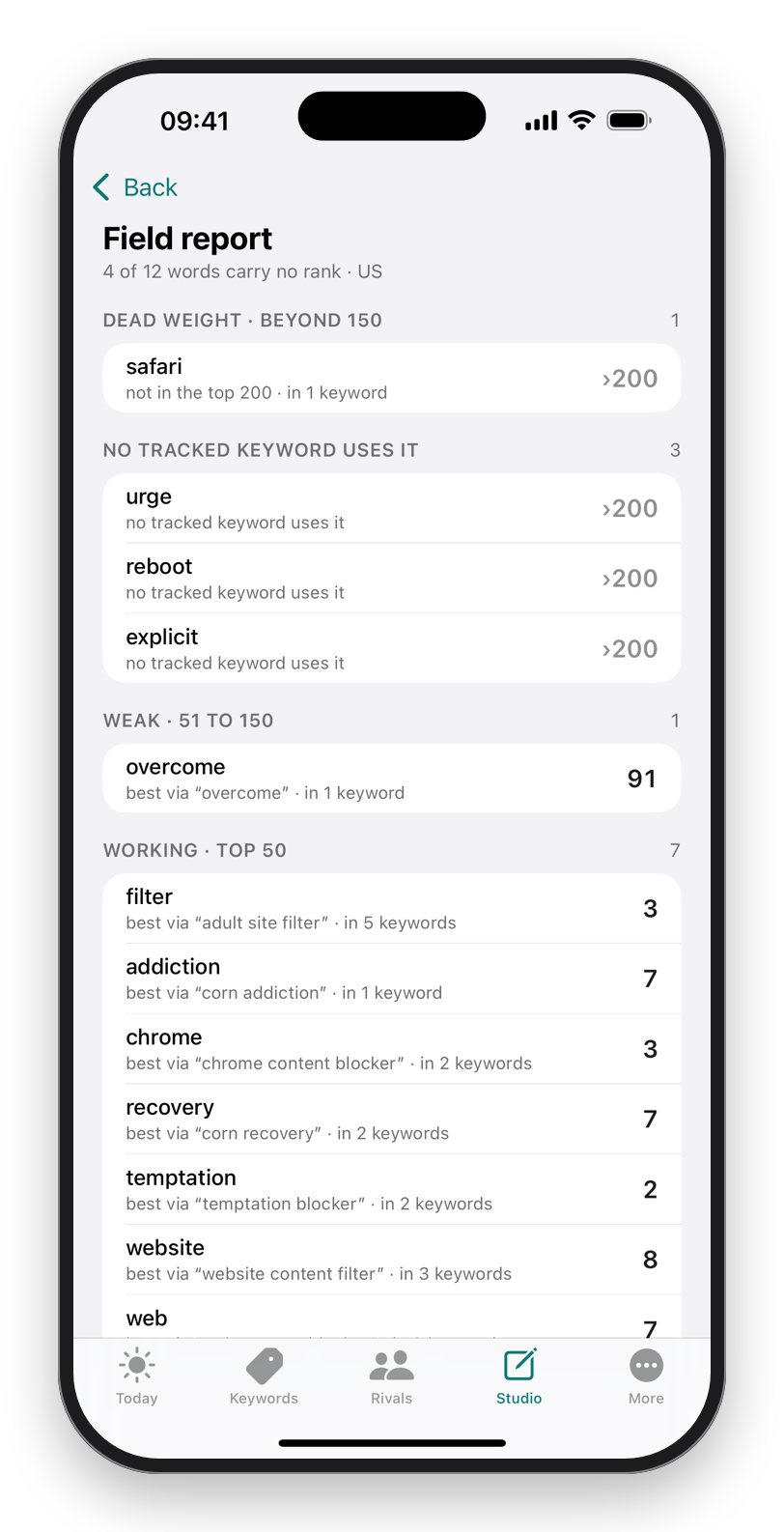
A dead keyword is a word in your 100-character keyword field that earns no rank on any term you track, in any storefront. Most indie listings carry three or four of them, which is a quarter of the field spent on nothing. Finding them takes one report: for each word, which tracked terms contain it and the best rank among them. RankASO's field report in Studio produces that from the daily checks already running, and for our own app Escape it named three words that came out of the field in the November version.
What "dead" means, precisely
A word is dead when every tracked term that contains it ranks past the point anyone scrolls, or ranks nowhere, in every storefront that reads the field. A word is weak when it earns a single rank far down on a one-word term. A word is working when at least one phrase that uses it sits in the top 30 somewhere. The field report shows the three states side by side, so the decision is a reading, not a feeling.
Escape's three
On the day of the November change the field report for the US store said:
| Word | Terms using it | Best rank | Reading |
|---|---|---|---|
| safari | safari blocker | past 200 | dead: the browser itself holds the term |
| lust | lust | past 200 (83 in Canada) | dead in the US; owned by a far larger app |
| reboot | reboot | 60 | weak: one word, one term, a rank nobody reaches |
Three words, seventeen characters with their commas. They became "gooning", "relapse" and "pmo", each backed by a tracked term with an open top 10 or an existing rank.
The procedure
- Track one term per field word. A word with no tracked term behind it cannot be judged. If you have fourteen words in the field, you need at least fourteen terms, plus the two-word phrases they form with the name and subtitle.
- Wait for a week of checks. One day's rank is a reading; a week is a trend.
- Open the field report. Sort by best rank. The bottom is your dead list.
- Before removing a word, check the coverage simulator. Some words earn nothing alone but complete a phrase with a name word. The simulator lists every tracked phrase a listing covers and shows what a removal stops covering, before you submit.
- Replace, do not just delete. The freed characters go to the Gaps list from your rivals or the store's completions, with a verdict of Go for it or Climbable.
- One change per version, baseline recorded, review at two weeks.
Why dead words happen
They were good ideas at launch and the store disagreed. Someone copied a competitor's list. A word was once part of a phrase in the subtitle that has since changed. The field was written once and never read again. None of these are mistakes; the mistake is not reading the report after the first month.
The words that only look dead
A brand word that earns nothing yet protects the brand phrase. A seasonal word that earns nothing in May and ranks in November; "nnn" on Escape's list is one. A word that completes a two-word phrase with the name. The report flags all three the same way, and the coverage simulator and a glance at the calendar separate them from the truly dead.
Download on theApp StoreFree to start. No account. Data Not Collected.
Questions
How do I know which keywords in my field are not working?
Track one term per field word, wait a week, and read a per-word report of which terms each word earns a rank on. The words with nothing under them are dead. RankASO's field report does this from the checks already running.
Should I remove a keyword that ranks at 60?
Usually. A rank nobody scrolls to earns nothing, and the characters can carry a word with an open top 10. Check the coverage simulator first in case the word completes a phrase that does rank.
How often should I check for dead keywords?
Once per version that touches the listing, and at least once a quarter. The store and your rivals change, and a word that worked last spring can be dead by autumn.