 RankASO
How App Store search works: what is indexed, what is not
Read in: 日本語 · 简体中文 · Português · Español · Deutsch
App Store search indexes three fields of your listing, the name, the subtitle and the keyword field, matches a search against any combination of the words in them, and orders the matching apps by how relevant and how well-performing the store judges each to be, separately in every country's storefront. The description, the screenshots and the what's-new text are not indexed for search. Knowing exactly what is read tells you where every word has to go, and what a rank tracker is actually measuring.
What is indexed
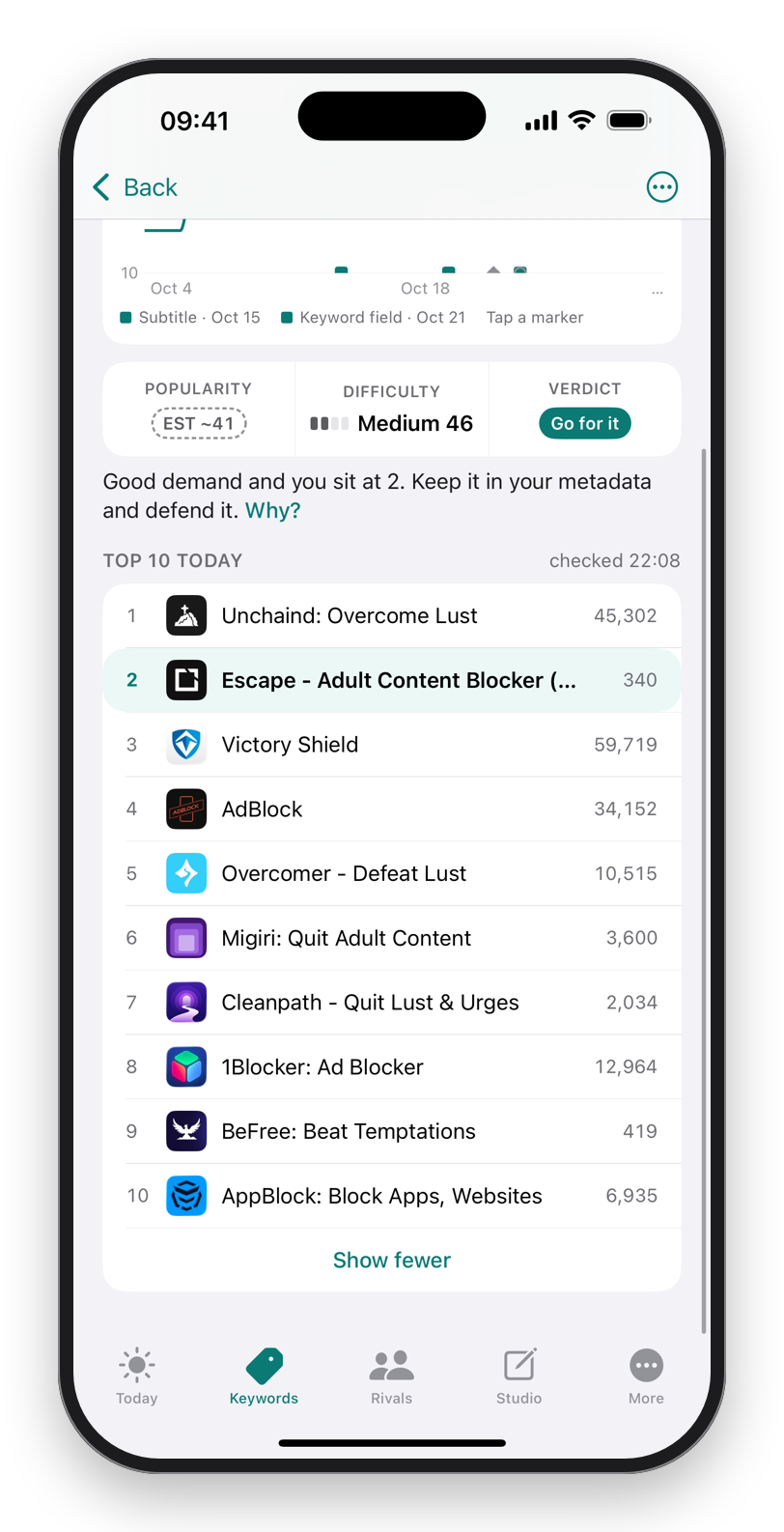
- The name, with the most weight. The words in it carry the terms you hold most strongly; for our own app Escape, the category phrase in the name holds number one on its own and in combination with the subtitle.
- The subtitle, with the next most weight. Thirty characters that combine with the name.
- The keyword field, 100 characters per locale, read as individual words and combined with the other two.
- The developer name, lightly.
- In-app purchase names, lightly, for apps that have them.
- The category the app is listed in, as context rather than as words.
The store also reads secondary locales' fields in some storefronts: the US reads Spanish (Mexico), Canada reads French (Canada). Which storefront reads what.
What is not indexed
The description, the promotional text, the what's-new notes, the screenshot captions and the reviews. Words that appear only there earn no rank. The description still matters, for conversion once someone has arrived, but a keyword that lives only in the description is not a keyword.
How matching works
Words are matched in combination across the three fields. "adult", "content" and "blocker" spread across the name and field match "adult content blocker", "content blocker" and "adult blocker". Singulars match plurals. Common filler words are ignored. The order of words in the field does not matter; the presence of each word does. This is why repeating a word, writing phrases with spaces, or adding plurals wastes characters, and why one well-chosen word can unlock several phrases at once.
How ranking works
Among the apps that match, the store orders by a relevance it reads from how exactly the words match and where they appear, and by performance signals it reads from the app's history: installs, especially installs that followed a search for that term, ratings and their count, and engagement. Then it personalises slightly for the individual user. A new listing starts with the relevance half only, which is why launch ranks move so much in the first two weeks as the performance half arrives. The seven-day cliff.
What a rank tracker measures
The neutral result for a term in a storefront, before personalisation, read at a consistent hour: your position among the matching apps as the store orders them for a user with no history. That is the number that changes when you change the listing and when rivals change theirs. RankASO reads it daily for every term and storefront you track, to position 200, and reads every rival's position from the same result.
What this means for your listing
Put the two phrases you most need in the name and subtitle. Put the next fourteen words in the field, one each, no duplicates, no filler. Fill the secondary locale your main storefront reads. Then measure, because the store's weighting is not published and the only way to know what your words earned is to track the terms they form.
Download on theApp StoreFree to start. No account. Data Not Collected.
Questions
Does the App Store index the description for search?
No. Only the name, subtitle and keyword field are indexed for search, plus the developer name and in-app purchase names lightly. The description matters for conversion, not ranking.
How does the App Store match keywords?
By combining the individual words across the name, subtitle and keyword field, in any order, matching singulars to plurals and ignoring filler words. One word can complete several phrases.
Why are App Store rankings different in each country?
Each storefront reads its own locale's fields, has its own set of competing apps and its own installs. The same listing can rank first in one country and nowhere in another.